
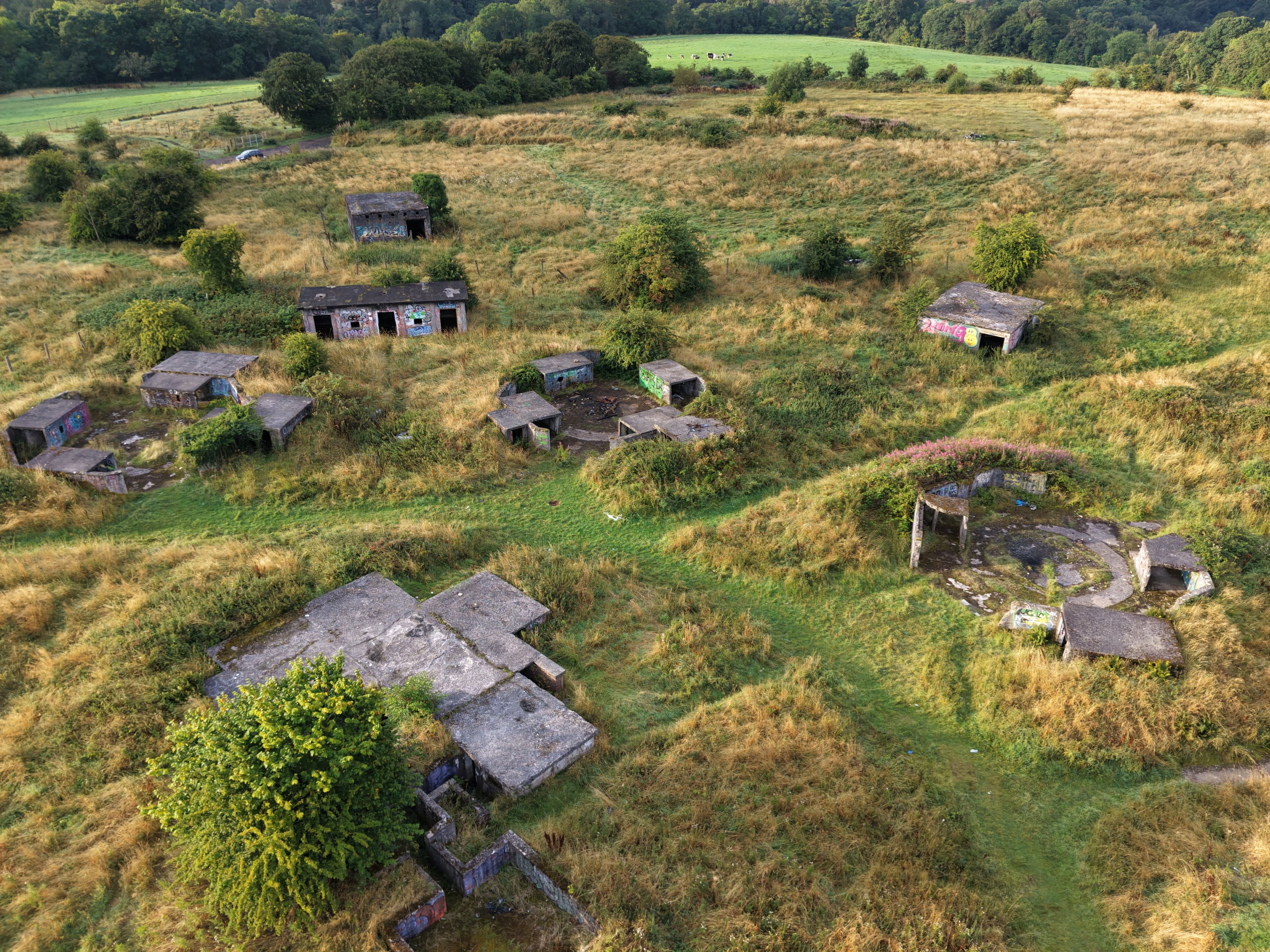
A place I flew
Carnbooth Anti-Aircraft Battery
The remains of a Second World War heavy anti-aircraft battery on Netherton Braes, south of Glasgow. Built as part of the Clyde’s air defences, Carnbooth retains concrete gun emplacements and support buildings, with evidence of later Cold War alteration.
- Latitude
- 55.79005° N
- Longitude
- 4.26197° W
About the location
The place itself
Carnbooth Anti-Aircraft Battery lies on Netherton Braes, in open ground west of Carmunnock on Glasgow’s southern edge. Although the setting is now largely rural, it was chosen for a serious wartime role: helping to defend Glasgow, the Clyde and their strategically important industries from air attack during the Second World War.
A wartime gun site
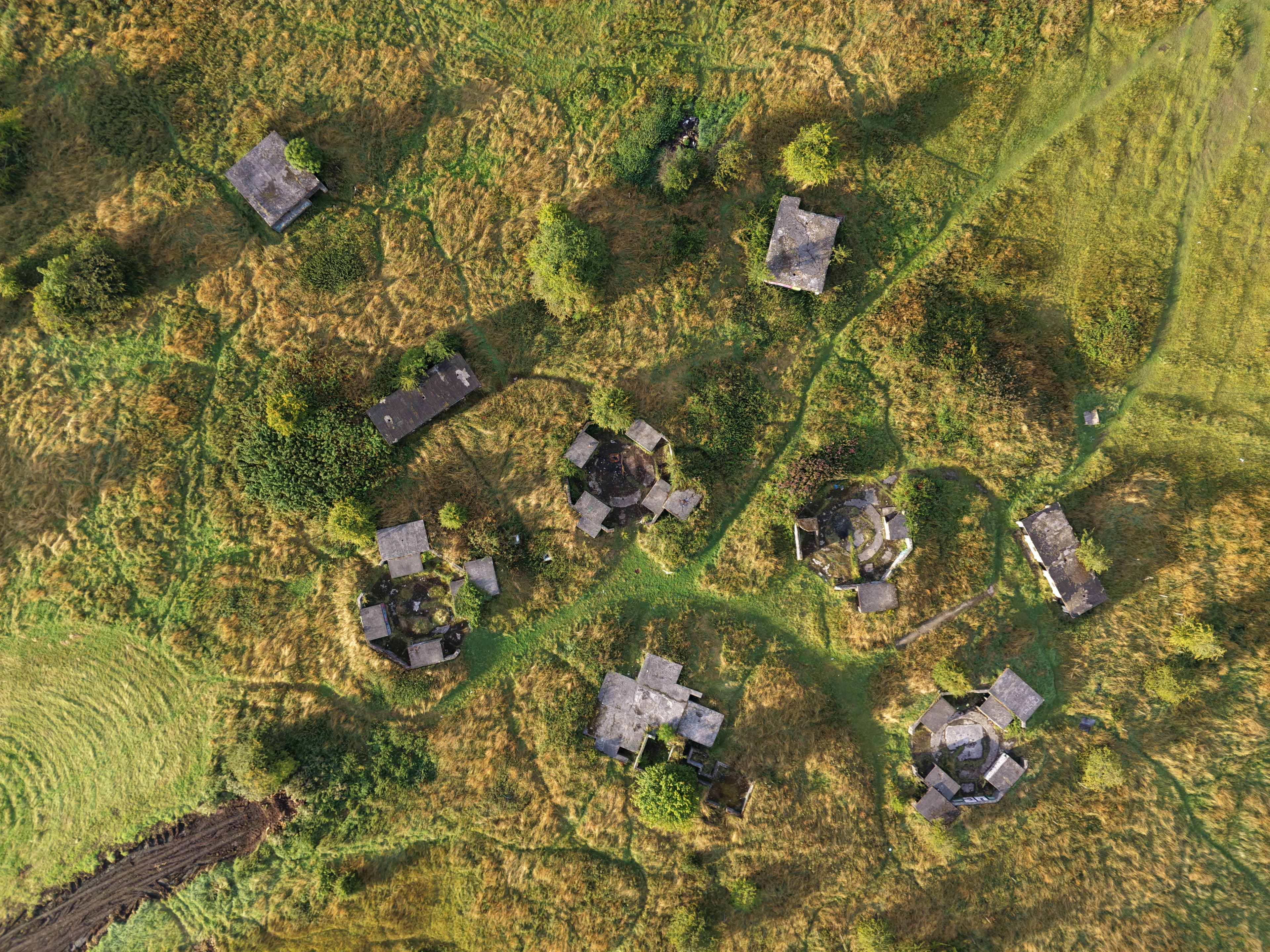
The site was a heavy anti-aircraft battery, arranged around four gun emplacements. These were supported by the practical buildings needed to operate a battery: a command post, magazines, a gun store, engine room and a computing room. A Gun Laying radar area stood to the north, while the accommodation camp for the personnel was placed to the east.
Rather than being a single isolated installation, Carnbooth formed part of the wider Clyde anti-aircraft defences. Its elevated position gave it a broad outlook over the approaches to Glasgow, while keeping it outside the dense built-up area it was intended to help protect.
What remains
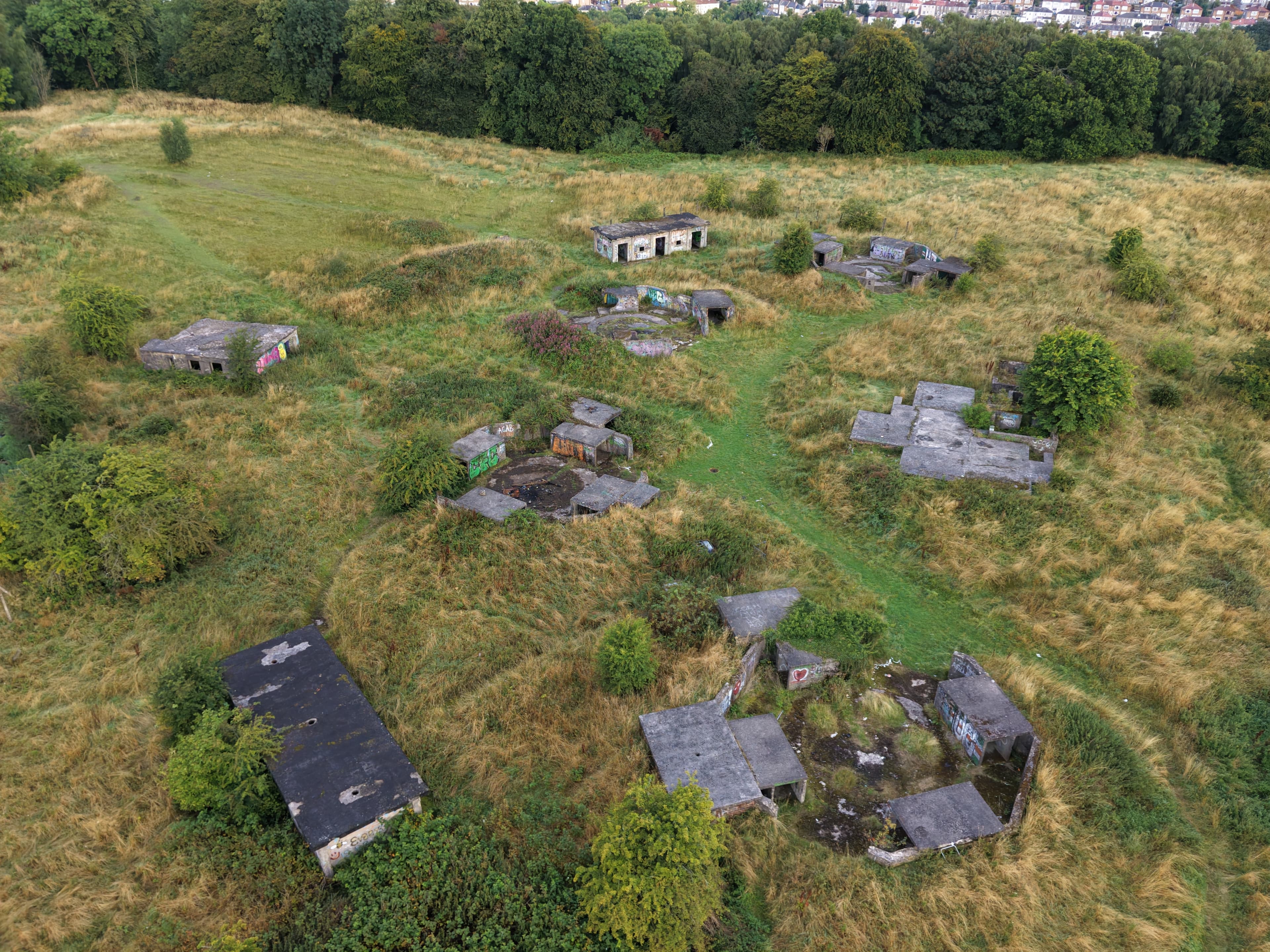
Much of Carnbooth survives as a group of brick and concrete structures. The four gun positions are still the clearest feature, their circular form and heavy construction making their former purpose fairly easy to read. The command and service buildings add to the sense that this was once a small, self-contained military workplace rather than simply a set of guns in a field.
The associated camp has not survived as completely. Its hut bases and other traces have been recorded to the east of the battery, but the lighter domestic buildings have proved less durable than the reinforced operational structures.
After 1945
Carnbooth did not simply close at the end of the war. Aerial photographs show that the site remained broadly intact into 1950, then acquired additional buildings between 1950 and 1954. These changes are understood as post-war anti-aircraft work, probably connected with Britain’s early Cold War air-defence arrangements.
That later layer is an important part of the site’s story. It helps explain why Carnbooth differs from a battery abandoned immediately after the war: the visible remains reflect both the emergency defence of wartime Clydeside and the uncertainty that followed it.
A fragment of Glasgow’s defensive landscape
Carnbooth is a useful reminder that the Second World War left marks far beyond city centres, docks and factories. On Netherton Braes, concrete emplacements and utilitarian buildings still show how the rural fringe around Glasgow was drawn into the protection of the city and the Clyde.
The battery stands within farmland and its condition and access arrangements may change. The structures should be treated as historic remains, with care for land, livestock and any restrictions in place.
Summer · 22 August 2026
Above the Long Grass
A calm but slightly chilly August morning at Carnbooth, reached through unusually high grass. I enjoyed the flight, and found the aerial view gave the old battery buildings a much better showing than their rubbish-filled interiors.
Notes from this flight
22 August 2026
22 August 2026
This was a calm Saturday morning in August, although it felt a little cold for the time of year. It was fine once I was there, but getting to the buildings meant walking through really high grass. A winter visit might make that part easier.
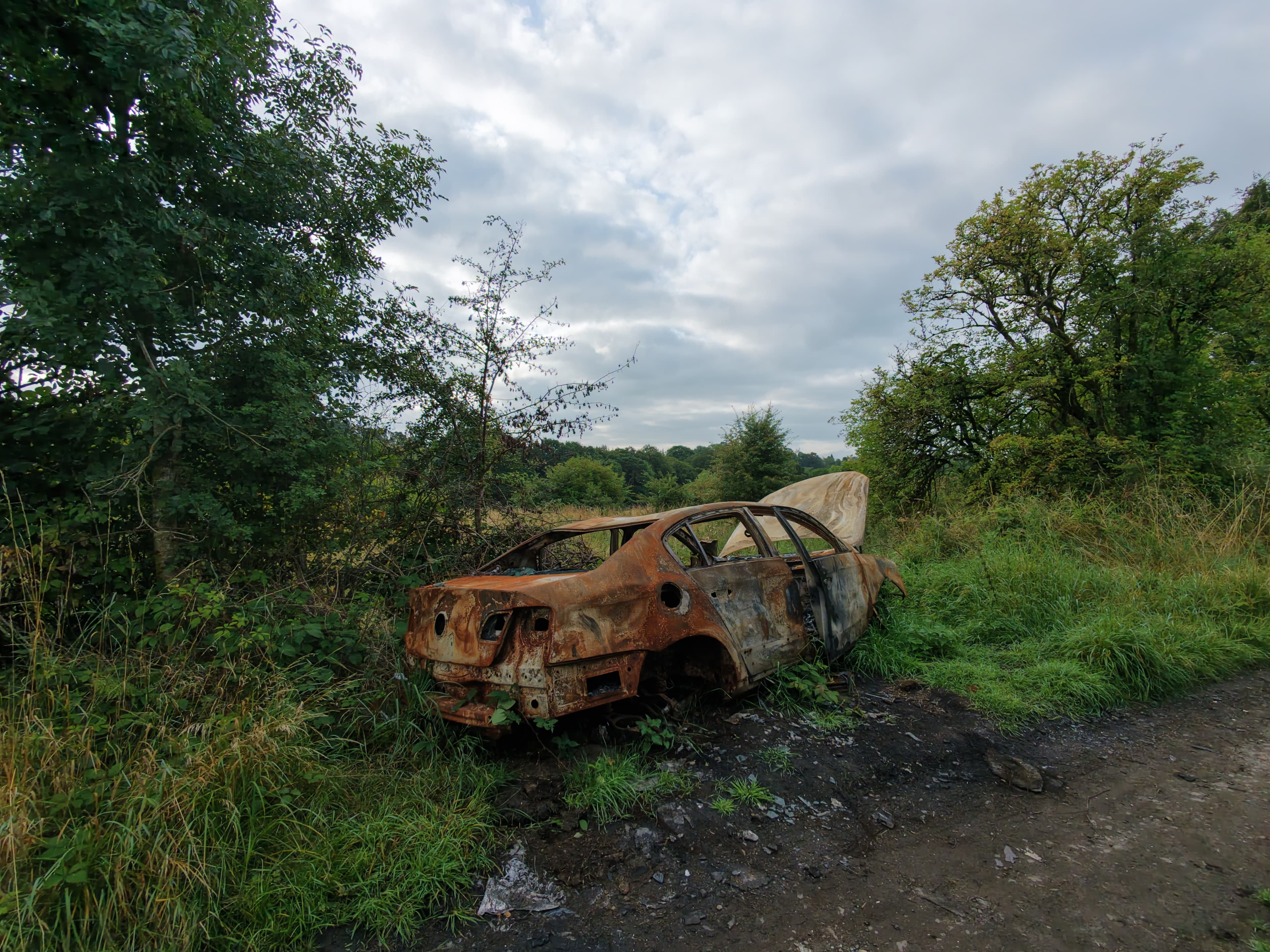
I otherwise enjoyed flying here. From above, the remains looked far better than they did from inside the buildings. Unfortunately, people have used some of them to dump rubbish, which takes away from the experience on the ground.
Carnbooth was a Second World War heavy anti-aircraft battery on Netherton Braes, forming part of the defences for the approaches to Glasgow and the Clyde. The site originally included four gun emplacements alongside support buildings, and later saw post-war alterations.
For this visit, though, the aerial perspective was the main thing. It brought out the layout of the old structures in a way that was much harder to appreciate at ground level.
Look around
The flight in 360°
An interactive view from this visit. Click to load it, then drag around the scene.
Aabattery 360 02
Gallery
Photos from this flight
Location
Roughly where it is
General area
Carnbooth Anti-Aircraft Battery
55.79005° N · 4.26197° W
The marker shows the general location only, not a take-off point.
Open in Google Maps